
A healthcare professional managing chronic pain juggles daily with scattered information: paper assessment scales, fragmented reports, incomplete patient feedback between consultations. This lack of continuity complicates the personalization of care and prolongs the time needed for therapeutic adjustments. Dedicated digital platforms are beginning to structure this follow-up, placing the professional at the center of the system rather than adding another administrative layer.
Real-time pain data: how digital follow-up changes things for the caregiver
Before digital tools, caregivers reconstructed the evolution of pain from the patient’s memories, which were often imprecise. The memory bias is well documented: a patient tends to remember their pain peaks, not the periods of relief.
A follow-up platform captures data between consultations. The professional accesses intensity curves, symptom diaries, and sometimes quality of life indicators filled out by the patient from home. This regular collection transforms the consultation: instead of spending ten minutes reconstructing an approximate history, the practitioner directly analyzes trends.
For example, it becomes possible to identify that lower back pain systematically worsens at the end of the week, which points to a professional or postural factor rather than a medication adjustment. This type of correlation, difficult to establish based on a quarterly interview, can access Mon Coach Douleur for professionals who wish to structure this analysis in their daily practice.
Continuous follow-up reduces the time spent reconstructing history during consultations. The caregiver shifts from data collection to interpretation, which significantly changes the quality of care.
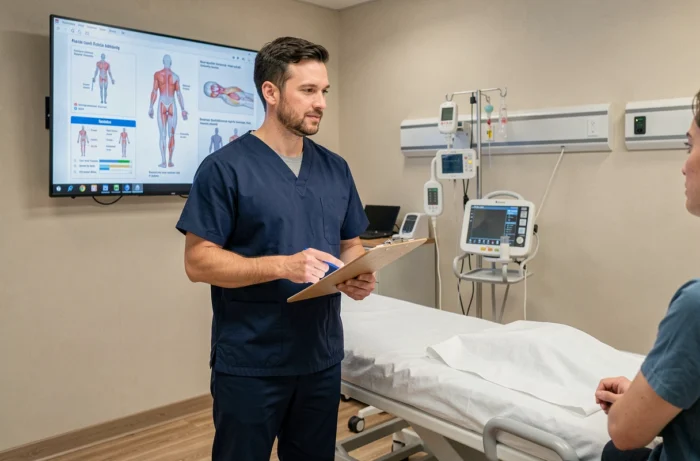
Coordination between city medicine and pain structures: a still fragmented journey
France has many specialized structures for managing chronic pain. The issue lies not in their number but in their integration with local care.
A general practitioner referring a patient to a pain center often loses visibility over the journey. Reports arrive late, sometimes by postal mail. The physiotherapist or nurse involved in rehabilitation does not always have access to the specialist’s recommendations.
What a platform can resolve in this chain
A shared space among professionals streamlines information transmission. The general practitioner sees the objectives set by the pain specialist. The physiotherapist consults the evolution of pain scores. The patient no longer repeats their story to each interlocutor.
This coordination does not replace multidisciplinary consultation meetings, but it fills the gap between two appointments. Have you ever noticed that a patient returns for a consultation without having followed another professional’s recommendations, simply because they did not understand or receive them? A platform that centralizes instructions limits this type of loss.
- The treating physician accesses non-drug prescriptions (exercises, relaxation, adapted physical activity) without waiting for the specialist’s letter.
- The patient has a single guiding thread, which strengthens their adherence to the care program.
- Paramedical professionals visualize the history of previous treatments, including therapeutic failures, to avoid repeating approaches that have already been attempted.
Health data compliance: a selection criterion often overlooked by caregivers
The data collected by a pain management platform (intensity, location, history, ongoing treatments, clinical evolution) falls under sensitive data as defined by Article 9 of the GDPR. In practice, this classification imposes specific requirements.
The patient’s consent must be explicit, not simply inferred from the use of the application. Storage must occur on certified servers for health data hosting. A data processing register must exist, and the retention period must be defined in advance.
Why this topic directly concerns the practitioner
A professional recommending an application to their patients takes on responsibility. If the platform does not meet security requirements, the caregiver is also exposed in the event of a data breach.
Checking the health data hosting certification before any recommendation should be as reflexive as checking the CE marking of a medical device. Few practitioners do this, often due to a lack of time or clear benchmarks. A serious platform transparently displays this information in its documentation for professionals.

Reimbursement of digital therapies: the game-changing timeline
The issue of funding remains a point of friction for digital solutions for pain management. Some applications, like QoLibri, are offered for free while awaiting a reimbursement decision. This provisional model shows that the prescription of a digital therapy does not yet guarantee a stable economic model for both the professional and the patient.
A decree dated August 21, 2026, with an expected implementation date of January 1, 2027, modifies the financial participation rules applicable to therapeutic digital devices and telemonitoring. This text paves the way for increased involvement of health insurance in financing these tools.
For the practitioner, this evolution has a direct consequence: digital solutions that anticipate this regulatory framework will be easier to integrate into a reimbursed care pathway. Those that remain in administrative ambiguity risk discouraging patients, even if their clinical content is relevant.
- Before recommending a platform, check if it falls within the upcoming reimbursement framework or if it relies entirely on a patient-funded model.
- Anticipate patients’ questions about cost, clearly distinguishing between free features and paid modules.
- Follow the evolution of the decree and its application modalities, which will specify the eligibility criteria for reimbursement by health insurance.
The landscape of digital tools for chronic pain is rapidly taking shape. Professionals who take an interest in it now, verifying both clinical robustness, regulatory compliance, and funding model, will be better positioned to offer their patients coherent care pathways as soon as the reimbursement framework stabilizes.