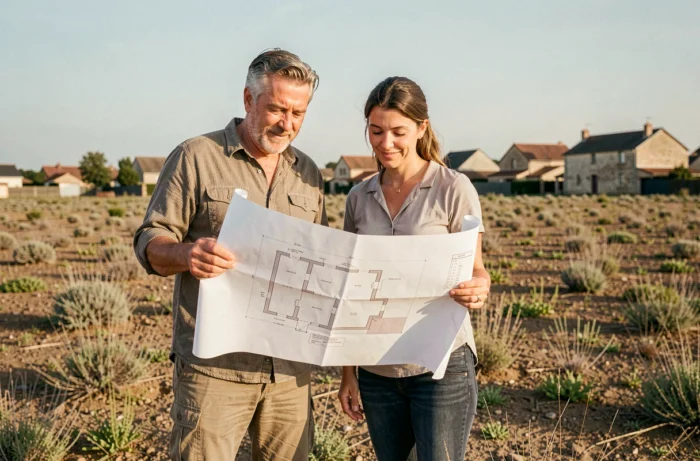
The individual construction market in Cher has seen a resurgence of activity since the beginning of 2026, driven in particular by the extension of the zero-interest loan for new houses across the entire territory. Bourges, the prefecture of the department, combines land advantages and a regulatory framework that deserve to be examined before signing anything. Here’s what the available data allows us to affirm, and the areas where caution remains advisable.
Clay soil in Cher: the risk to check even before the land
Most future homeowners start by looking for land, then a builder. The reverse order would sometimes be wiser, as the soil study determines the type of foundations and the overall budget.
Cher has many plots classified in areas of medium or high exposure to clay shrink-swell. According to regulations stemming from the ELAN law, the seller of a buildable plot located in these areas must provide a prior geotechnical study. This requirement is not cosmetic: without it, cracks related to drought cycles can appear a few years after delivery.
The official Géorisques map allows you to check the classification of a plot in just a few clicks. To precisely design the foundations, a complementary design study may be necessary, depending on the nature of the subsoil. The cost of this study remains marginal compared to the total budget of a house, but its absence can lead to considerable additional costs in foundation repairs.
Among Ecb Bâtiment houses in Bourges, projects integrate this geotechnical constraint from the design phase, which avoids unpleasant surprises during construction.
Expanded PTZ for new houses: what it concretely changes in Bourges
Since its extension to the entire territory, the zero-interest loan now applies to new individual houses, including in Bourges. The scheme is set to last until December 31, 2027, according to information published by Service-Public.fr in September 2026.
Several points deserve clarification:
- The PTZ only finances part of the project. For a new individual house, the share varies according to income brackets, with an estimated range between 10 and 30% of the selected cost according to Batinfo.
- Income and first-time buyer conditions apply. A household that has owned its primary residence in the last two years is generally not eligible.
- The bank remains free to assess the overall creditworthiness of the application. Obtaining the PTZ does not guarantee approval of the main loan.
The PTZ thus serves as a lever, not as an independent financing option. Feedback from the field varies on this point: some buyers overestimate the portion covered by the scheme and find themselves with a fragile financing plan.
RE2020 and construction in Bourges: thermal constraints and material choices
The environmental regulation RE2020, in effect for individual houses, imposes thresholds on three axes: energy performance, the building’s carbon footprint over its life cycle, and summer comfort.
In Bourges, the moderate continental climate implies cold winters and increasingly hot summers. Summer comfort becomes a full-fledged design criterion, not just a bonus. Solutions involve the orientation of the building, the sizing of openings, solar protections, and the choice of materials with high thermal inertia.
Wood, brick, concrete block: decide based on the project
Wood frame construction meets the carbon requirements of RE2020 well, as wood stores CO2. However, its thermal inertia is lower than that of a brick or concrete house, which can complicate the management of summer comfort without additional systems.
Monomur brick offers a good compromise between insulation and inertia. Concrete block, less thermally efficient, remains competitively priced and requires careful added insulation to meet regulatory thresholds.
No material is universally superior: the choice depends on the land, budget, orientation, and priorities of the project owner. A local builder familiar with the climatic constraints of Berry will be better positioned than a general catalog to arbitrate these parameters.
Construction budget in Bourges: items that quotes do not always detail
The prices per square meter announced online vary greatly. The search context mentions a wide range, but these figures mask significant discrepancies depending on the included services.
Several items are frequently underestimated or absent from initial estimates:
- The servicing of the land (connection to water, electricity, and sanitation networks) can represent a significant amount if the plot is far from existing networks.
- The geotechnical study and any special foundations in clay areas, already mentioned, are not always included in the displayed base price.
- Interior finishes (equipped kitchen, floor coverings, outdoor arrangements) are sometimes excluded from the CCMI construction contract, which skews the comparison between quotes.
- Additional costs: development tax, notary fees on the land, damage insurance.
Comparing quotes requires checking the exact scope of services. A low price per square meter only makes sense if the list of included items is identical from one builder to another.
The CCMI as a protective framework
The individual house construction contract remains the most regulated legal framework for an individual. It imposes a firm and definitive price, penalties for delays, a delivery guarantee, and a ten-year insurance. Ensuring that the builder offers a CCMI, and not just a simple project management contract, is a non-negotiable prerequisite.
The construction market in Bourges today offers a favorable context, with accessible land and expanded financing options. Regulatory constraints (RE2020, soil study, seismic standards where applicable) are not obstacles but safeguards that protect the investment in the long term. The quality of a project is measured less by the displayed price than by the rigor with which each item has been anticipated.