
An inflatable kayak is a flexible craft made up of independent air chambers and a cover made of PVC or reinforced synthetic fabric. Its rigidity depends on the inflation pressure, the number of chambers, and the construction technology used. Before comparing the available models, precisely identifying your navigation program and the associated regulatory constraints helps avoid an unsuitable purchase.
Regulatory status of inflatable kayaks in France: a criterion before the technical sheet
Most buying guides start with size or the number of seats. However, the administrative status of the kayak should be checked first, as it determines the places where you can navigate.
In France, an inflatable kayak intended to remain within the 300-meter band of a shelter may fall under the category of “beach craft.” A longer or stiffer model does not automatically grant access to more distant coastal navigation. To venture up to 2 nautical miles from a shelter, regulations require a device that allows reboarding after capsizing and an individual flotation device of at least 50 N per person.
Human-powered vessels under 3.50 m may benefit from registration exemptions, but this exemption depends on specific characteristics. If you plan to fish at sea or navigate beyond the areas close to shore, the actual administrative status of the kayak must be verified before purchase, and not just its number of seats or payload.
Knowing how to choose an inflatable kayak therefore requires integrating this regulatory dimension from the start, or you risk ending up with a model prohibited on the intended waterway.
Materials and construction: what distinguishes a durable inflatable kayak
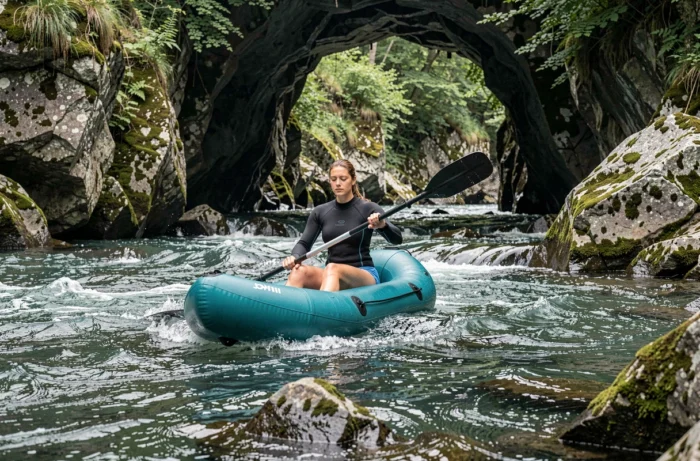
The material of the cover determines both the shock resistance, the total weight, and the longevity of the kayak. Two main families dominate the inflatable kayak market.
Coated PVC remains the most common material for entry-level and mid-range models. It offers a good compromise between manufacturing cost and abrasion resistance. High-end models use nylon or polyester fabrics with polyurethane coating, sometimes reinforced by a dropstitch structure (threads stretched between two layers of fabric) that allows for higher inflation pressures and thus rigidity close to that of a rigid kayak.
The compatibility between the kayak material and the provided repair glue is a technical point often overlooked. An inappropriate repair kit for the type of fabric will render any patch ineffective in the field. Check that the manufacturer specifies the compatible type of glue and that replacement patches are available.
Valves: the weak link to inspect
Slow leaks most often occur at the valves, not on the seams or the fabric. Boston-type valves, common on budget models, have a higher failure rate than lockable spring valves. Before purchasing, two questions deserve a clear answer: are the valves user-replaceable, and are spare parts available from the manufacturer?
Stability, maneuverability, and comfort according to water type
A wide inflatable kayak will be more stable but slower. A narrow model will gain in speed and maneuverability, at the cost of requiring more balance. This compromise is directly reflected in the length/width ratio of the hull.
- In calm water (lake, canal, slow river), a wide kayak with a flat bottom provides reassuring stability for beginners and is suitable for family outings where comfort takes precedence over performance.
- In moving water (class I to II), a shorter model with raised side tubes improves responsiveness to directional changes and better withstands eddies.
- At sea, within the authorized coastal band, the presence of a removable keel or directional fins limits lateral drift caused by wind and chop.
Sitting comfort directly affects the duration of outings. An inflatable seat adjustable in height and tilt reduces lower back fatigue on multi-hour trips. Models with a simple flat bottom without a backrest are suitable for short trips, rarely beyond an hour.

Load capacity and number of seats: adapting the inflatable kayak to its crew
The maximum load capacity indicated by the manufacturer includes the weight of the paddlers and all the equipment on board. Exceeding this limit degrades buoyancy, lowers the waterline, and makes the kayak difficult to maneuver.
A 2-person inflatable kayak remains the most versatile format: usable in pairs or solo with additional storage space. Models with 3 seats or more are suitable for families, but their bulk once inflated complicates maneuvers in narrow rivers.
The weight of the deflated kayak stored in its transport bag is a decisive practical criterion. A model that you cannot carry alone to the launch point will eventually remain in the trunk. Assess the actual distance between your usual parking spot and the shore before validating a heavy but spacious model.
Storage and integrated accessories
Elastic nets on the deck, tie-down rings, and paddle holders are not cosmetic details. On a multi-hour outing, a waterproof container or cooler must be securely fastened without hindering the paddle stroke. Check the presence and strength of these attachment points, as adding them later to an inflatable kayak is rarely reliable.
The choice of an inflatable kayak is based on a logical sequence: first the regulatory framework of your navigation area, then the quality of construction (materials, valves, reparability), next the suitability of the hull shape to your water type, and finally the actual capacity relative to your use. Neglecting any one of these steps exposes you to a kayak that performs well on paper but is unsuitable on the water.