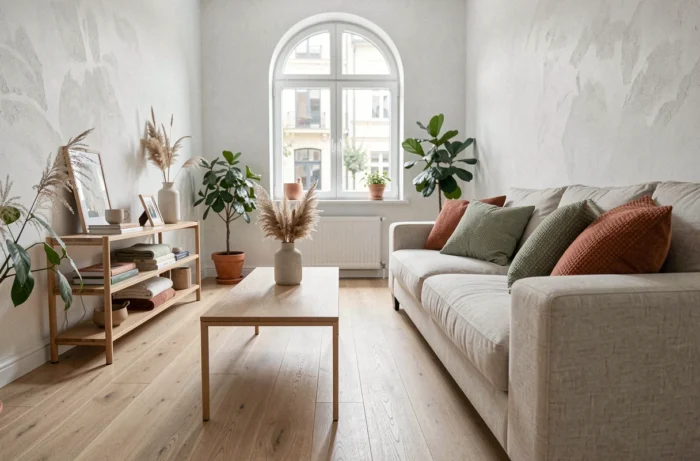
French interiors are changing their tune. After several years dominated by Scandinavian minimalism and its cool grays, the design projects of 2026 are leaning towards more enveloping palettes, sustainable materials, and furniture designed to evolve with usage. This shift affects both color choices and the way circulation in a room or the versatility of a piece of furniture is conceived.
Warm Neutrals and Cloud Dancer: the palette that redefines interior ambiance
The clinical cold white is receding. The Pantone color of the year 2026, Cloud Dancer (Pantone 11-4201), a soft and airy white, sets the tone for a broader trend. Current palettes rely on warm neutrals (beige, sand, greige, ivory) punctuated by deep shades like terracotta, olive green, burgundy, or midnight blue.
This shift is not just aesthetic. A sand or greige wall absorbs natural light differently than pure white: it softens harsh contrasts during the day and maintains a sense of warmth in the evening, without requiring as pronounced supplementary lighting. For a north-facing living room or bedroom, the result can significantly alter perceived comfort.
Deep shades work in touches. A terracotta wall in a predominantly ivory room visually structures the space without reducing the sense of volume. Several designers recommend testing these accents on reversible elements (cushions, curtains, small furniture) before committing to paint. Field feedback varies on the ideal balance between warm colors and dark accents, as perception greatly varies depending on natural light and room size.
The home ideas circulating on the home section on Oka Mag illustrate this movement towards interiors that are both understated and warm, far from the standardized all-white.
Modular furniture and sustainable design: a standard of design, not an option
Modular furniture is no longer confined to small spaces. In 2026, it asserts itself as a full-fledged design principle, even in large volumes. The central idea: a piece of furniture that adapts to uses is better than three fixed pieces.
In practical terms, this translates into sofas whose modules reconfigure according to occasions, extendable tables that switch from desk to dining table, or shelves whose structure accommodates interchangeable accessories. This is not a gimmick. For a living room that also serves as an office or playroom, modularity solves a real problem of circulation and storage.
Local and recycled materials in interior decoration
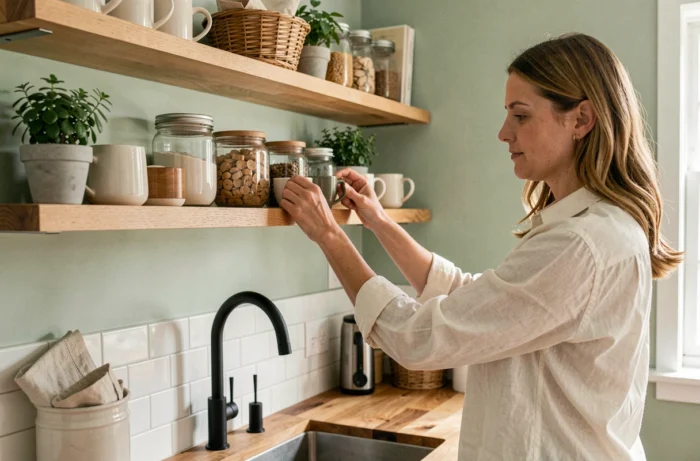
Sustainable design accompanies this logic. Local, recycled, or low-impact materials are becoming a common selection criterion in design projects. Certified wood, French linen for textiles, artisanal ceramics: the origin of the material weighs as much as its appearance in the final choice.
The available data does not allow for precise quantification of the market share of sustainable furniture in France, but the trend is evident in the catalogs of major retailers, which expand their eco-designed ranges each season.
- Favoring local wood species (oak, beech, ash) reduces transport footprint and often ensures better traceability than exotic woods.
- Textiles made from recycled fibers (recycled polyester, regenerated cotton) now offer textures comparable to virgin fibers, which was not the case a few years ago.
- Second-hand furniture, restored or patinated, naturally fits into the warm neutral palettes of 2026 and adds a unique dimension that standardized new items do not replicate.
Heritage style in decoration: mixing eras without falling into pastiche
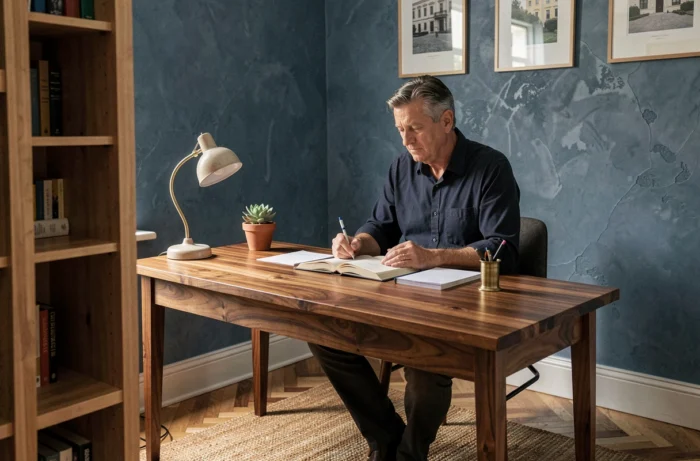
Among the decoration trends of 2026, heritage style stands out for its way of mixing antique pieces with contemporary furniture. A 1960s armchair facing a polished concrete coffee table, a gilded mirror above a raw metal console: the assembly relies on controlled contrast, not on recreating an era.
This style implies renouncing total homogeneity. Coherence comes from the color palette and proportions, not from stylistic unity. A living room fully furnished in the same style (all mid-century, all industrial) tends to resemble a showroom. In contrast, three or four pieces from different eras connected by a similar range of shades create an interior that has a story.
Inspiration and selection of vintage pieces
The difficulty lies in the selection. Not all antique furniture works well together, and accumulation without a guiding thread produces the opposite effect of what is sought. A few concrete guidelines help to sort:
- Check proportions before style: a massive buffet in a narrow living room overwhelms the space, regardless of its decorative value.
- Limit “statement” pieces to one or two per room. The rest of the furniture should remain understated so that the accents stand out.
- Test associations on a small scale (a vintage object placed on contemporary furniture) before investing in bulky pieces.
Interior layout and circulation: rethinking volumes in daily life
A trendy interior that functions poorly in daily life remains a decor, not a living space. The question of circulation between areas (kitchen, living room, entrance) is often addressed after aesthetic choices, when it should precede them.
A clear passage of at least 80 cm between two pieces of furniture remains the reference for smooth circulation. Below this, the feeling of clutter sets in, even in a room that is objectively spacious. Open spaces (kitchen-living room) require special attention: without partitions, it is the furniture itself that delineates the areas. A sofa placed perpendicular to the wall, a rug marking the living room corner, a console separating the entrance from the living area: these elements replace walls without blocking light.
A common pitfall in current design projects is to overlap too many functions in the same space without prioritizing. Identifying the main function of each area before furnishing avoids ending up with a living room-office-playroom where no activity has true comfort. It is better to have a room that fulfills two functions well than a space that skims over four.
The decor trends of 2026 converge on the same observation: a successful interior relies less on the accumulation of objects than on the accuracy of choices, whether it is a shade, a material, or the placement of a piece of furniture. The Cloud Dancer palette, sustainable furniture, and heritage style share this principle of active sobriety, where each element has a reason to be there.