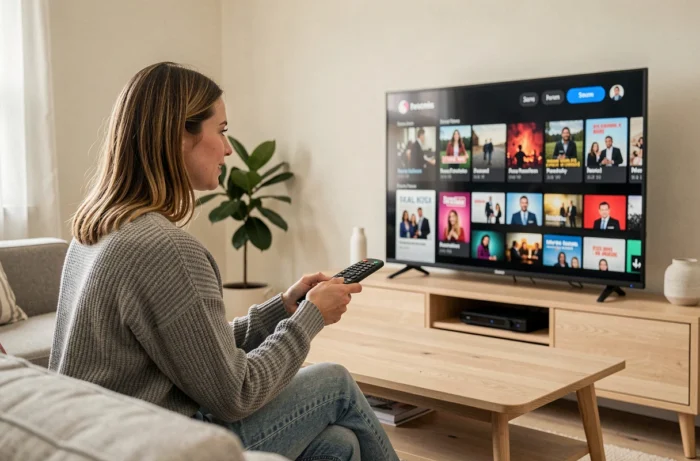
The video streaming market is no longer limited to a handful of generalist giants. Specialized platforms now occupy specific segments: auteur cinema, niche sports, scientific documentaries, anime, regional content. This fragmentation changes the way we assess the quality of a streaming service, going well beyond the simple price/catalog ratio.
Codecs and Adaptive Bitrate: What Video Quality on Streaming Platforms Hides
The image quality displayed by a platform does not depend solely on the advertised resolution. The codec used (AV1, H.265/HEVC, VP9) and the encoding profile determine the actual rendering on screen. A specialized platform that encodes in AV1 at a generous bitrate on a limited catalog often produces a superior image compared to a generalist service streaming in H.264 across thousands of titles.
Adaptive bitrate (ABR) remains the decisive factor for user experience. Niche platforms, with less simultaneous server load, can more easily maintain a stable bitrate. On high-traffic services, switching to a lower tier in case of network congestion results in visible compression artifacts, especially in dark scenes or fast movements.
We observe that several platforms specializing in cinema offer streams in HDR10+ or Dolby Vision across their entire catalog, whereas generalists reserve these formats for a fraction of their content. For a viewer equipped with a compatible television, the difference is immediate.

European Regulatory Obligations and Impact on VOD Catalogs
The European Union adopted the European Media Freedom Act (EMFA) in April 2024, a regulation that imposes strengthened requirements for pluralism, transparency, and protection of content of general interest for online media services, including streaming platforms. This framework adds to the Audiovisual Media Services Directive (AVMSD), which already sets a quota for European content in catalogs.
For specialized platforms, these obligations represent both a structural advantage and a constraint. A service focused on European cinema automatically meets the quotas, while a catalog dominated by American productions must invest in local acquisitions that are sometimes disconnected from its editorial line.
We recommend checking if the targeted platform clearly distinguishes the advantages of Fusov streaming, which partly stem from this logic of specialized curation, naturally aligning the catalog with regulatory constraints without diluting the editorial proposition.
Right of Withdrawal and Streaming Subscriptions
The CJEU has strengthened the right of withdrawal for digital subscriptions, including streaming. A subscriber who signs up online has a withdrawal period, unless they have expressly consented to the immediate execution of the service and acknowledged the loss of this right. Several specialized platforms still do not comply with this information obligation, which exposes the user to difficulties when canceling early.
AVOD vs. SVOD Business Model: The True Cost of a Specialized Platform
The ad-free subscription model (SVOD) dominates specialized platforms. Their more limited catalog does not generate enough audience volume to make an advertising model profitable. Generalists, on the other hand, now offer hybrid AVOD plans at reduced prices that appeal to budget-conscious subscribers.
This distinction has direct consequences on the experience:
- In pure SVOD, no advertising interruptions, but a monthly price often equivalent to that of a generalist service despite a smaller catalog
- In AVOD, the entry cost drops significantly, at the price of advertising breaks whose frequency varies by platform (some insert ads every ten minutes)
- Some niche services operate on a TVOD basis (purchase or rental per unit), which suits occasional viewers but is more expensive for regular consumption
The choice of model depends on viewing habits. For daily use, a subscription remains more economical. For a few films a month on an art-house cinema platform, renting per unit avoids paying for an underutilized subscription.

Interoperability and Content Fragmentation Between Platforms
The proliferation of subscriptions is the main criticism directed at specialized streaming. A household that combines a generalist service, a sports platform, and a cinema service quickly reaches a monthly budget higher than that of the old cable subscription.
No universal aggregator currently allows searching for a title across all catalogs from a single interface integrated into televisions. The universal search functions offered by Apple TV or Google TV remain incomplete: they do not index all specialized platforms, particularly the smaller ones.
Account Portability and Multi-Screen
Cross-border portability, guaranteed by the European regulation on the portability of online content, works for temporary stays within the EU. However, specialized platforms often limit the number of simultaneous screens to one or two, compared to four or five on generalist platforms. For a household with multiple people, this restriction impacts daily use.
Downloaded offline content poses another problem: some niche platforms simply do not offer this feature, making them unusable on the go without a stable connection.
Editorial Curation vs. Recommendation Algorithm
Specialized platforms rely on human editorial curation rather than recommendation algorithms trained on millions of profiles. The result: less personalized suggestions but often more coherent with an artistic or thematic line.
A generalist algorithm optimizes viewing time. Editorial curation prioritizes discovery and diversity within a genre. For a documentary enthusiast, the latter approach prevents being trapped in a bubble of similar content.
This curation logic attracts a loyal but limited audience. The churn rate on specialized platforms remains higher than on generalists, as perceived value drops as soon as the catalog seems exhausted. The actual depth of the catalog, measured in hours of renewed content each month, is therefore the criterion to watch before subscribing.
Specialized streaming does not replace a generalist service: it complements it for targeted use. Evaluating the codec, business model, regulatory constraints, and curation policy before subscribing helps avoid paying for a service whose technical or editorial quality does not match actual usage.