
At the end of each month, civil servant teachers expect to see their salary appear in their account on a specific date. When the transfer does not occur in July 2026, the situation generates legitimate stress, especially since the summer period complicates communication with the administration. Understanding the possible causes of a delay and knowing the concrete remedies allows for a timely response.
Interbank delay and actual transfer date in July 2026
Before discussing delays in a legal sense, it is important to distinguish between the official payday and the date the transfer appears on a bank statement. The ministry acknowledges a possible gap of one to two working days between the announced date and the actual credit, related to interbank processing times.
In practice, a teacher who sees nothing in their account on the official payment day should wait until the second working day following. It is only after this period that they are justified in considering that there is a genuine delay in payment. General union bulletins rarely remind of this margin for a specific deadline, which sometimes fuels premature concerns.
If a salary delay for teachers in July 2026 persists beyond these two days, the situation then falls under an administrative malfunction that should be formally addressed.

Cyber risks and IT tools: the threat of the 2026 school year
Salary delays are not always caused by a shortage of managers or a poorly recorded grade change. In the summer of 2026, a new dimension emerged: computer incidents and cyberattacks disrupted payroll management systems in several academies.
According to alerts reported by Ouest-France and La Dépêche at the end of August 2026, teacher unions expressed concerns about the administration’s ability to prepare September’s payroll, with some even mentioning a scenario where “staff salaries might not be paid” if the tools were not restored in time. In Ariège, the disruption of IT tools forced services to revert to paper processing.
This context makes delays in July and the following months potentially different from those in previous years. A teacher experiencing a delay in July 2026 cannot rule out that the cause is technical rather than administrative, which changes the way to address the issue.
Concrete steps in the face of an unpaid salary
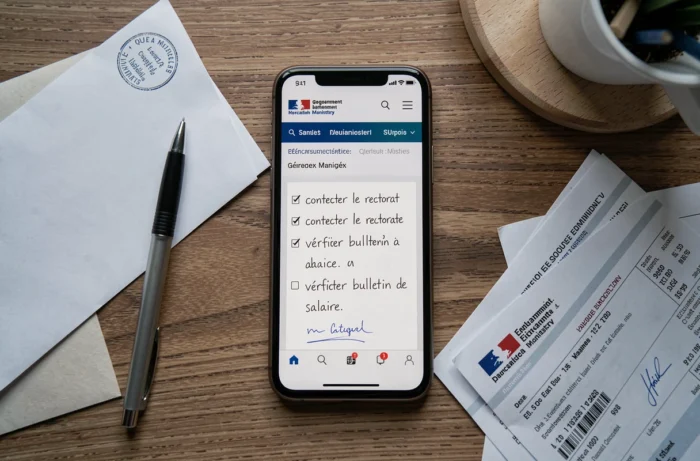
When the delay is confirmed (beyond the interbank delay), the remedies are organized in progressive levels. Here are the steps to follow in order.
- Contact your payroll manager by email, specifying your agent number, the period concerned, and the nature of the shortfall (base salary, allowance, bonus). Keep a dated copy of each exchange, as it will serve as proof in case of escalation.
- Simultaneously alert your local union section, which has direct contacts with the rectorate and can consolidate reports to expedite the processing of cases.
- If no regularization occurs within a reasonable time, send a registered letter to the academy rector reminding them of the principle of service rendered: any teacher who has fulfilled their service obligations has a claim against their employer.
- As a last resort, take the matter to the administrative court. This route remains rare, but it is available as long as the administration does not respond within the legal deadlines.
A often overlooked point: check your digital payslip on ENSAP before taking any action. The portal allows you to identify whether the problem stems from an incorrect bonus code, an unaccounted grade change, or a lack of total processing. This diagnosis directs the complaint to the right contact.
Particular case of transferred or newly assigned teachers
The most common situations of non-payment concern agents who have changed academies, grades, or assignments. The transfer of the file between two managing services creates breaks in the payroll chain. For July 2026, the reported IT disruptions amplify this risk.
A transferred teacher who notices the absence of their salary must contact both the old and new academies, as the file may be blocked in either service without either taking the initiative to follow up.
Late payment interest: a little-used right by teachers
When a payment delay is confirmed, the teacher can claim late payment interest from the administration. This right stems from the general principle that any debt owed by the state accrues interest from the date the payment should have been made.
The applicable rate is that of the legal interest in force, published every six months. In practice, the amounts remain modest for a delay of a few weeks, but the process has a primary virtue: it formalizes the harm and often accelerates regularization.
To obtain this interest, it is sufficient to request it in the registered letter addressed to the rector. No judicial procedure is required at this stage. Feedback from the field varies on this point: some teachers quickly achieve results, while others encounter administrative silence that necessitates union follow-up.
Prescription and deadline to claim an unpaid salary
A teacher has a deadline to claim an unpaid amount. Beyond this period, the claim is barred, and the administration is no longer obliged to regularize. The available data does not allow for citing a uniform deadline applicable to all situations in 2026, as specific provisions may vary depending on the nature of the amount (salary, bonus, allowance).
The basic precaution remains to never let a delay linger without written reaction. A dated email to the manager interrupts passivity and constitutes the first link in a chain of evidence that can be used in case of prolonged dispute.
For teachers facing a delay in July 2026, the combination of a tense cyber context and reduced administrative staff during the summer makes responsiveness more necessary than in previous years. Acting as soon as the third working day after the official payment date, with documentation in support, remains the best protection against a delay that becomes entrenched.