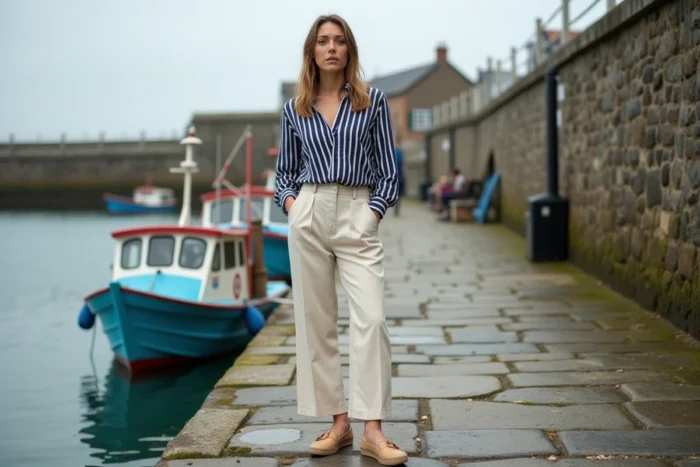
A regional textile sector is taking shape in Brittany around local materials, artisanal know-how, and a visual identity that goes beyond the simple marine motif. The subject deserves a closer look at what is actually made, worn, and transformed in the region.
Recycled Sails and Ropes: Breton Fashion Through Its Maritime Materials
An unknown segment of contemporary Breton creation relies on the recycling of materials from the nautical world. In Lorient, a workshop produces bags and accessories from old boat sails, with public visits available by appointment. This type of production illustrates a positioning that most classic ready-to-wear brands do not occupy: transforming worn technical material into urban fashion pieces.
Boat sails, made of technical fabric resistant to water and UV rays, possess properties that cotton or wool do not offer. The result yields rigid, lightweight pieces, often marked by the traces of use from the original fabric. This is not a marketing gimmick: it is a sector of eco-design that relies on an abundant material source in Breton ports.
The creators who work with these materials are part of a regional circular economy logic. The raw material comes from local shipyards and sailing clubs, which shortens the supply chain. To explore other facets of this regional textile scene, the Jolie Breizh fashion site references several brands and creators active in Brittany.

Breton Wool, Linen, and Cotton: What the Fibers Say About Regional Style
The marine sweater in wool remains a key piece in the Breton wardrobe. Its original function was utilitarian: to protect sailors from the damp cold. Traditional knits used dense, often unbleached wool, with a sufficiently thick weight to ensure insulation even when wet.
Today, several Breton brands continue to produce sweaters in local wool or cotton, preserving knitting techniques inherited from maritime tradition. Linen, historically grown in Brittany (the region was a major production area for linen fabrics), is making a comeback in some collections.
- The wool used for traditional marine sweaters often comes from sheep breeds adapted to the oceanic climate, giving it a natural resistance to moisture
- Breton cotton, particularly that of the marinières, is distinguished by a tight weave that maintains the garment’s shape after many washes
- Linen, a lightweight and breathable plant fiber, finds its place in summer shirts and jackets that recall the region’s textile heritage
The choice of fiber determines both the style and the durability of the garment. A genuine wool marine sweater ages differently than a sweater made from synthetic blends: it develops a patina, does not pill in the same way, and retains its thermal properties for several years.
Second Hand and Slow Fashion in Brittany: An Offer That Is Taking Shape
Breton fashion is not only played out in creation workshops. In Saint-Brieuc, the collective Les Culottées d’Armor has opened a seasonal second-hand shop, with a curated selection and extended hours. This type of initiative goes beyond a simple garage sale: second hand is becoming an organized and visible offer in the city center.
This trend is set against a backdrop of changing legislation. Recent laws aimed at reducing the environmental impact of the textile industry are changing the rules of the game for ready-to-wear players. Second-hand shops and local creators who produce in small series are mechanically favored by a framework that penalizes ultra-fast fashion.

Some Breton merchants are noticing an increase in foot traffic in thrift stores and local creator shops. Others point out that price remains a barrier: a marinière made in Brittany costs significantly more than an equivalent produced abroad.
Marinière and Sailor Hat: Iconic Pieces Between Tradition and Upcycling
The marinière is the most identifiable piece of the Breton wardrobe. Its military origin (it equipped sailors of the national navy) gives it a historical legitimacy that few garments possess. The marinière is not just a striped motif; it is a technical garment that has become a cultural symbol.
The sailor hat, another classic, has followed a similar path. Worn by fishermen to protect themselves from the wind, it has become a fashion accessory adopted well beyond Brittany. The question that arises for these two pieces is one of authenticity: at what point does a Breton garment cease to be one?
- A marinière knitted in cotton in a Breton workshop with traditional weaving is part of regional know-how
- A marinière printed in series on polyester at the other end of the world, adorned with a “Brittany” motif, falls under tourist merchandising
- Between the two, a wide spectrum of productions exists, and the consumer often has no simple means of distinguishing one from the other
The Role of Labels and Origin Mentions
Unlike food, textiles do not have a widely recognized protected designation of origin system. A few labels exist (Origine France Garantie, for example), but their presence on Breton garments remains uneven. The available data does not allow for precise measurement of the share of Breton textile production that benefits from a traceable label.
This absence of a clear framework benefits brands that play on the Breton imagination without any real connection to the territory. It penalizes workshops that produce locally and whose manufacturing costs reflect artisanal work.
Breton fashion is undergoing a period of redefinition. Between maritime recycling, a return to natural fibers, the structuring of second-hand, and questions of traceability, lines are shifting. Authentic Breton style is distinguished less by a motif than by a production chain rooted in a territory, identifiable materials, and know-how.