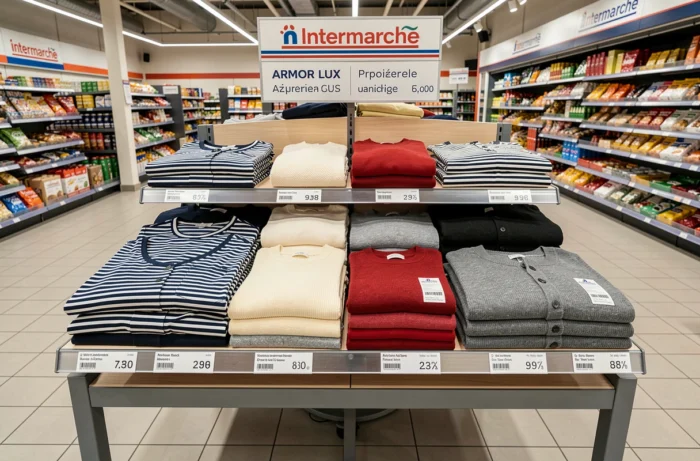
The Armor Lux sticker operation at Intermarché runs from May 12 to August 2, 2026. Eight items from the Breton brand are offered with a stated discount of up to 78%. The mechanism relies on a sticker collector linked to the loyalty card, but the actual cost per item varies depending on the number of stickers accumulated and the residual price requested at checkout. Which items are worth the collection effort, and where is the real saving?
Accumulating Armor Lux stickers and Intermarché vouchers: the overlooked double discount
Most guides on this operation focus on the number of stickers needed and the reduced price per item. They overlook a complementary lever: the periods of reimbursement in vouchers that Intermarché schedules in parallel.
During certain promotional windows, the store reimburses part of the receipt in vouchers, at the same time stickers are credited. Specifically, a customer who concentrates their purchases on these dates accumulates both stickers for the Armor Lux collector and a pot that can be used later.
This synergy changes the calculation of the actual cost. An item priced at a few euros after stickers can be even cheaper if the corresponding receipt generates a voucher. To identify these windows, simply check the Armor Lux collection at Intermarché and cross-reference the dates with your store’s weekly flyers.
Actual price per Armor Lux item: comparison with and without a filled collector
The system works in tiers. Each checkout with the loyalty card generates stickers proportional to the amount spent. Once the collector is filled, the item is available at a reduced price. Without a full collector, the standard catalog price applies.
| Armor Lux Item | Category | Collector Required | Value for Money Interest |
|---|---|---|---|
| Pouch | Small accessory | Yes (stickers) | Low investment, daily use |
| Insulated bottle | Small accessory | Yes (stickers) | High demand, frequent shortages |
| Fouta | Beach | Yes (stickers) | Most sought-after item along with the bottle |
| Child poncho | Beach | Yes (stickers) | Useful in coastal areas |
| Backpack | Luggage | Yes (stickers) | Versatile, regular use |
| Marine bag | Luggage | Yes (stickers) | Armor Lux signature, weekend format |
| Travel bag | Luggage | Yes (stickers) | Larger volume than the marine bag |
| Cabin suitcase | Luggage | Yes (stickers) | Highest residual price in the range |
Customer feedback on social media confirms that the insulated bottle and the fouta are the two most requested items. They are also the ones that disappear the fastest from the shelves, sometimes within the first few weeks.
Small accessories vs. luggage: where to place your collection effort
Entry-level items (pouch, bottle) require the same filled collector as larger items, but their residual price is lower. The effort/saving ratio favors small accessories for customers whose weekly basket remains modest.
In contrast, the cabin suitcase represents the highest residual price. The saving in euros is greater on luggage, but it requires a sufficient volume of purchases to fill the collector within the allotted time.
Intermarché loyalty card and app: what the digital format changes
The Intermarché loyalty card is the non-negotiable condition for participation. Without it, no stickers are credited. Two formats coexist:
- The paper collector, distributed in-store, on which the adhesive stickers are manually affixed after each checkout
- The Intermarché app, which automatically credits stickers to a digital collector, without physical handling
- The Intermarché drive, which also generates stickers provided the loyalty card is linked to the online account
The digital format has a concrete advantage: no risk of losing a half-filled paper collector. The app also allows real-time tracking of the number of accumulated stickers and the number remaining before unlocking an item.
Drive and Armor Lux stickers: an underutilized channel
Orders placed via the Intermarché drive generate stickers just like in-store purchases. This channel is rarely mentioned in point-of-sale communications. For customers who prefer the drive, ensuring that the loyalty card is properly linked to the account helps avoid missing out on stickers with each order.
Promotion ceilings and regulations: why the discount does not exceed a certain threshold
The displayed discount of 78% may be surprising. However, it is still regulated. French law, consolidated by the law of April 14, 2025, sets promotion ceilings at 40% for non-food consumer goods, extended until April 15, 2028.
The sticker operation circumvents this limit because it does not constitute a classic promotion in the commercial sense. The mechanism relies on prior collection (the stickers accumulated through purchases), which ties it to loyalty operations rather than direct discounts in-store.
This legal distinction explains why Intermarché can display a discount greater than 40% on non-food items. However, the vouchers generated by the parallel reimbursement operations remain subject to the usual ceilings.
Armor Lux stock shortages in-store: which items to watch
Each point of sale manages its own stock. Testimonials shared on social media report shortages as early as the first weeks on foutas and insulated bottles, particularly in stores located in coastal or tourist areas.
- The fouta and insulated bottle are the first to disappear, often well before the end date of the operation
- Luggage (marine bag, cabin suitcase) remains available longer as their residual price deters some buyers
- The child poncho experiences variable shortages depending on the store’s location
Filling your collector early in the operation remains the only reliable strategy. Waiting until July to start collecting risks finding empty shelves for the most sought-after items. The operation runs until August 2, 2026, but stocks do not necessarily follow this schedule.
The choice of which item to target should be made at the beginning of the collection. Concentrating your stickers on a specific item, while checking its availability in-store before validating the collector, avoids the disappointment of a filled booklet for a product that is out of stock.