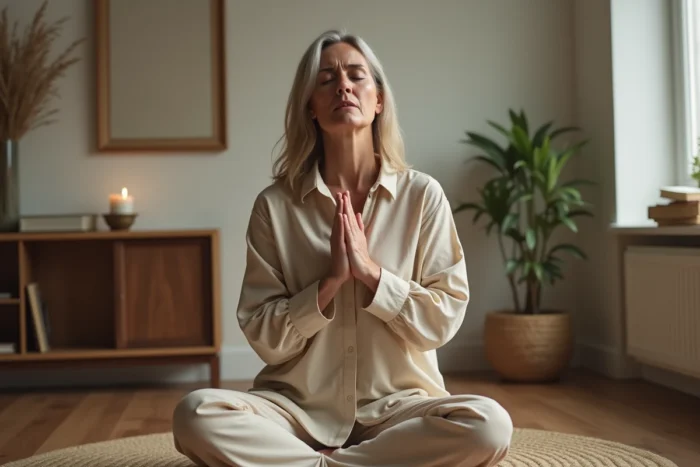
You are focused, eyes closed, hands joined, and suddenly, a yawn arises. Then a second one. This phenomenon affects practitioners of all faiths, often at the moment when they seek the greatest contemplation. Far from being a sign of laziness or disinterest, yawning during prayer has precise physiological roots that recent research sheds new light on.
Yawning during prayer and brain thermoregulation
The most counterintuitive explanation is also the most documented. Yawning primarily serves to regulate brain temperature. When you pray, your body relaxes, your breathing slows down, and your brain needs a slight cooling to maintain its alertness.
Imagine a laptop placed on a cushion: without proper ventilation, it overheats. Yawning acts like a small internal fan. The intake of fresh air through the mouth and nose lowers the blood temperature that supplies the brain.
This mechanism explains why we yawn more in a warm or poorly ventilated room, as confirmed by the explanations available on Klottra regarding this. An overheated church in winter or a poorly aired prayer room multiplies yawns, regardless of your level of devotion.
Parasympathetic nervous system and state of prayer
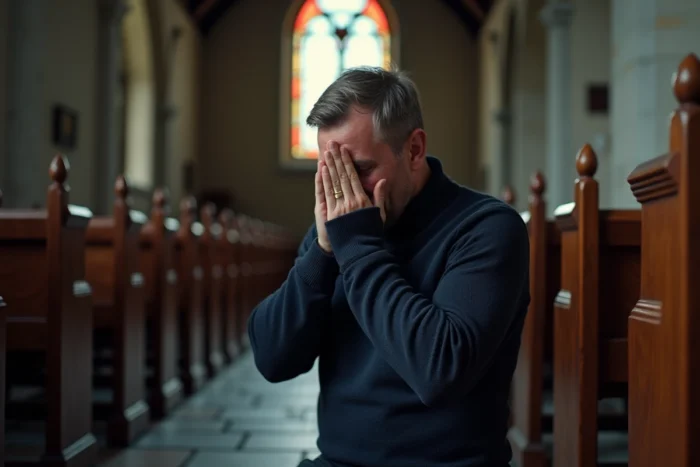
Have you ever noticed that yawns rarely occur when you are running or when you are angry? The body has two main modes of nervous functioning. The “alert” mode (sympathetic) speeds up the heart and tenses the muscles. The “rest” mode (parasympathetic) does the opposite.
Prayer, especially individual and silent, strongly activates the parasympathetic nervous system. Heart rate slows down, muscles relax, and breathing becomes slower and deeper. This shift towards rest creates a very favorable ground for yawning.
A Geneva pastor interviewed on the subject summarizes the situation well: solitary prayer deeply relaxes, and this relaxation reflects a feeling of trust. In a group, the social dynamic maintains a higher level of alertness, which limits yawning. This is why many practitioners find that they yawn when alone but not in assembly.
The difference between collective prayer and solitary prayer
In a group, your brain remains in social mode. It monitors the reactions of others, adjusts your posture, follows the collective rhythm. This social vigilance prevents a complete shift to the parasympathetic.
Alone, nothing hinders this shift. Your body interprets silent prayer as a signal of total safety and relaxes accordingly. Yawning alone in prayer is a sign of deep relaxation, not spiritual weakness.
Transition of state of consciousness: what yawning signals
Neuroscience provides a third perspective. Yawning is now described as a marker of transition of state of consciousness. It signals that the brain is shifting from one mode of operation to another.
Think of the morning yawn upon waking or the evening yawn before sleeping. In both cases, the brain changes regime. During prayer, the same phenomenon occurs: you shift from external attention (the noises, the light, your daily thoughts) to internal and focused attention.
This change of mode requires neurological effort. Yawning accompanies this transition as a recalibration signal. Rather than fighting it, some meditation practitioners welcome it as an indicator that the brain is entering a state of inner concentration.

Reducing yawns during prayer: concrete suggestions
Understanding the mechanism does not eliminate discomfort, especially when yawns become repetitive and hinder concentration. Several simple adjustments can reduce their frequency without forcing.
- Ventilate the room before praying or open a window. Fresh air on the face limits the rise in brain temperature that triggers the reflex.
- Breathe deeply through the nose for a few minutes before starting. This pre-ventilation stabilizes brain temperature and reduces the need to yawn afterward.
- Change your posture if you always pray sitting or lying down. Praying standing or walking maintains a slightly higher level of physiological alertness.
- Check your sleep. Very frequent and uncontrollable yawns may reveal an underlying sleep disorder or a side effect of certain medications.
The Islamic tradition recommends covering the mouth with the hand when a yawn occurs during prayer. This gesture, beyond its spiritual dimension, mechanically slows the opening of the jaw and can shorten the yawn.
When to consult a doctor
Very frequent yawns that also occur outside of prayer deserve medical advice. Some treatments (psychotropics, antihistamines) can cause excessive yawning as a side effect. An undiagnosed sleep disorder can also manifest through this symptom.
If yawns remain limited to moments of prayer or relaxation, the cause is almost certainly physiological and benign.
Yawning during prayer is neither a lack of faith nor a defect in concentration. It is the normal response of a brain that is cooling down, relaxing, and changing mode. Adjusting ventilation, posture, and sleep is sufficient in the vast majority of cases to regain a more serene contemplation.