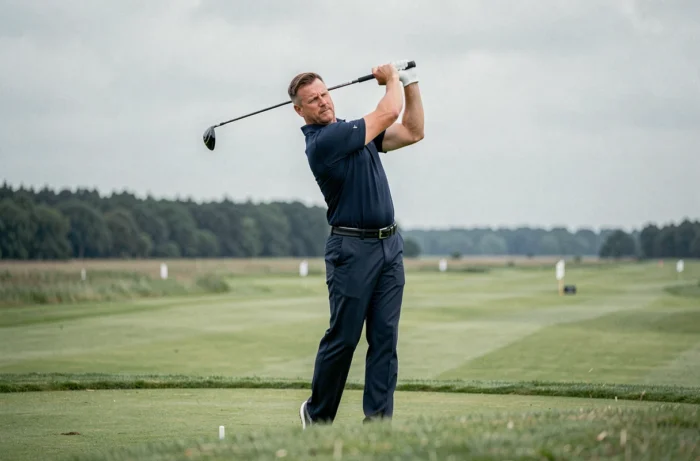
The long drive is not just about hitting hard. The discipline requires a combination of club head speed, launch angle, and controlled spin rate on a regulation fairway about 45 meters wide. In Belgium, this niche of golf attracts a handful of specialized competitors who train according to protocols that are very different from traditional golf.
Biomechanical parameters of long drive: what separates a hitter from a competitor
Club head speed is the distinguishing factor. Long drive competitors work on specific kinetic sequences: hip-shoulder dissociation pushed beyond what a traditional golfer seeks, full extension of the dominant arm at impact, and the use of ground reaction force to maximize vertical energy transfer.
The equipment is radically different from golf on the course. The shafts used in competition have stiffness and weight profiles suited to swing speeds that mainstream manufacturers do not target. The driver heads allowed comply with the rules of the game (limited volume, capped coefficient of restitution), but the chosen lofts often go very low to optimize the relationship between launch angle and backspin.
We observe that the majority of Belgian competitors who progress rapidly incorporate physical preparation focused on explosive power, with rotational medicine ball exercises and hip strength training. The Belgian community around this discipline is gradually structuring itself, and local players can be found on longdriversbelgium.be, which centralizes information about athletes and national events.

European LDET circuit and Belgium’s place in the calendar
The Long Drivers European Tour (LDET) has been organizing a pan-European calendar since 2012 that includes Belgium among its stops. This circuit now covers Italy, France, Germany, Austria, the United Kingdom, and Spain, a sign of a professional structuring of long drive in Europe.
For a Belgian competitor, the LDET represents the main pathway to qualification for the world championships. The competition format remains standardized: each player has six to eight balls within a set time, and only the longest ball that stays within the fairway limits is counted.
Specifics of the qualifying format
The LDET events operate in elimination rounds. Competitors go through pool phases, followed by direct confrontations. This bracket system imposes a consistency that the simple distance record does not reflect. A long driver must produce long hits AND stay in the fairway under direct pressure, which radically changes the tactical approach compared to free training.
Belgium, despite its size, benefits from a geographical position that facilitates access to neighboring stops (France, Netherlands, Germany). Belgian competitors thus accumulate several events per season without heavy logistical constraints.
Profile of Belgian long drive champions
The Belgian long drive scene remains confidential compared to national circuits of traditional golf. AFGolf results cover traditional senior and amateur championships, but long drive evolves in a parallel ecosystem.
Belgian athletes who perform in long drive share a recurring profile:
- A sports background outside of golf (throwing sports, rugby, athletics), which provides a base of power that can be exploited after technical conversion
- A hybrid training regimen combining swing sessions on radar (like Trackman or GCQuad) and specific physical preparation two to three times a week
- Regular participation in LDET events to accumulate competition time under regulatory conditions, with closely mowed fairways and official measurement
The Golf de Rougemont, in the province of Namur, has highlighted its ties to the discipline by publicly congratulating its pro for performances in long drive. This type of local recognition helps legitimize the discipline among traditional clubs.

Media coverage and professionalization of long drive
Long drive is also professionalizing in terms of broadcasting and audience. The World Long Drive Championship, whose final takes place in the United States, benefits from ESPN broadcasts and an official YouTube channel that accumulates views on short formats pitting long drive champions against PGA Tour players.
Kyle Berkshire remains the dominant figure used as a reference in this content. Comparative formats (long drive champion versus circuit professional versus amateur) generate massive engagement and help raise awareness of the discipline well beyond its historical base.
Impact on the Belgian scene
This international visibility indirectly benefits local communities. Belgian clubs that host demonstrations or introductions to long drive are seeing growing interest, particularly among practitioners who do not find themselves in the traditional format of stroke play over 18 holes.
The World Long Drive Championship has found a new permanent site in Reno-Tahoe, with an agreement running at least until 2028. This geographical stability facilitates planning for European competitors, including Belgians, who aim for world qualification.
- European qualifications via the LDET remain the main route to the world final for Belgians
- Live broadcasting on ESPN and YouTube expands the recruitment pool for new practitioners
- Long drive attracts a different audience than traditional golf, younger and more attuned to athletic spectacle
Belgian long drive remains a micro-community, but its direct connection to the European LDET circuit and the global professionalization of the discipline offers it a structured competitive framework. For Belgian golfers tempted by pure power, the entry barrier is technical, not financial: a driver, a swing radar, and access to the practice range are enough to start measuring one’s potential.