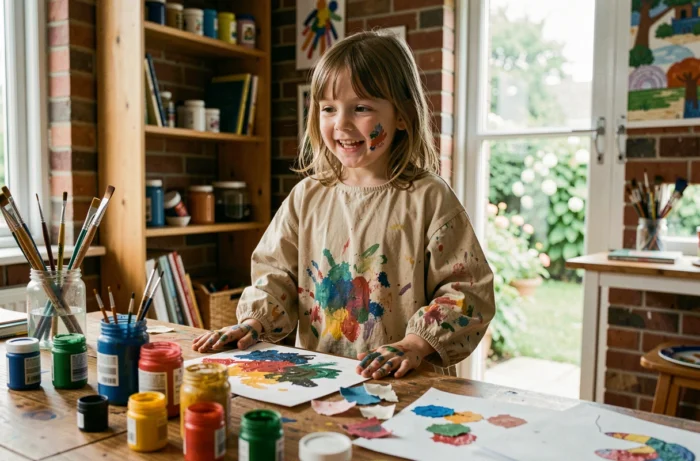
Child creativity is not just about providing craft materials and waiting for the magic to happen. Encouraging creativity and boldness in children requires a precise parental stance, thoughtful environmental choices, and a nuanced understanding of what distinguishes creative production from mere occupation.
Cognitive Boldness and Open Problems: How Scientific Activities Make a Difference
Children’s creativity develops significantly better when faced with problems that have no single solution. We observe that approaches focused exclusively on visual arts miss out on a powerful lever: playful scientific activities with open problems.
A study published in 2026 in Innovation and Education documents that scientific games involving trials, errors, and multiple hypotheses encourage measurable cognitive boldness in children in a school environment. A child who tests a hypothesis, sees it fail, and then formulates another without adult intervention develops a tolerance for uncertainty that free drawing does not engage in the same way.
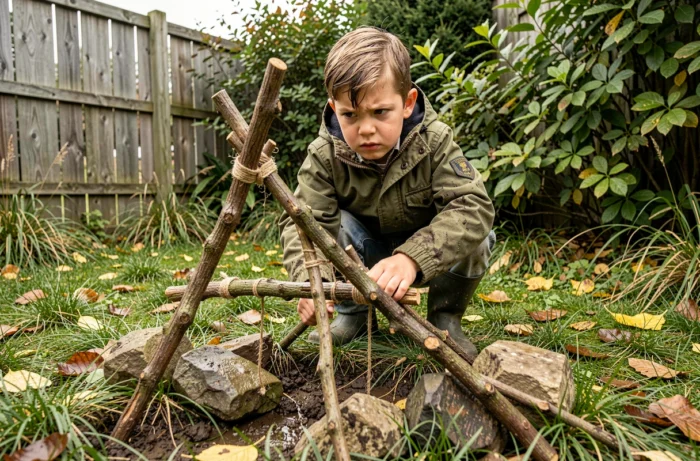
Specifically, asking a child to build a stick bridge capable of supporting a given weight, without providing a model, simultaneously activates divergent thinking and perseverance. Boldness arises from the right to structural failure: the collapse of the bridge is not a fault, it is a given.
Resources dedicated to supporting children’s education from a creative perspective exist, notably at https://enfantsterribles.fr/, which addresses these topics from a complementary angle to traditional school approaches.
Creative Screens vs. Passive Screens: A Technical Distinction to Master
We recommend abandoning the binary discourse on screens. Recent research draws a clear line between two modes of use whose effects on creativity diverge radically.
A Finnish study that followed children over eight years, reported by ScienceDaily in September 2026, shows that active digital uses seem to be associated with cognitive benefits in children. Programming, video editing, digital drawing, interactive storytelling: these activities engage imagination and decision-making. In contrast, passive consumption of content (looped videos, scrolling) does not produce the same effects.
Most general articles settle for “limit screens” without qualifying the modalities. This vague recommendation deprives parents of a real tool. A child who programs a small game on Scratch or edits a stop-motion video mobilizes creative skills comparable to those in a collage workshop.
The decisive criterion is simple: does the child produce something or consume a stream? If the screen serves as a medium for creation, it falls into the category of tools. If the child is a spectator, the time spent does not nourish creativity.
Active Parental Mediation: The Method that Structures Boldness
The parent’s stance towards the child’s creative activities determines the quality of the outcome much more than the materials provided. Researchers refer to active parental mediation to describe a set of documented practices:
- Co-constructing usage rules (time, tools, spaces) with the child, rather than imposing them unilaterally, develops decision-making autonomy and the confidence necessary for creative boldness.
- Discussion during and after the activity, where the parent asks open questions (“What did you want to show?”, “What surprised you?”) rather than validating the result (“It’s beautiful”).
- Shared use of tools, digital or otherwise, where the parent participates without directing. Drawing together without a common model, for example, normalizes risk-taking.
Celebrating the process rather than the result is the pivot of this method. A child who hears “you tried three different approaches before finding this one” develops a fundamentally different relationship with boldness than one who hears “it’s pretty.”
Everyday Environment and Creativity: Often Overlooked Parameters
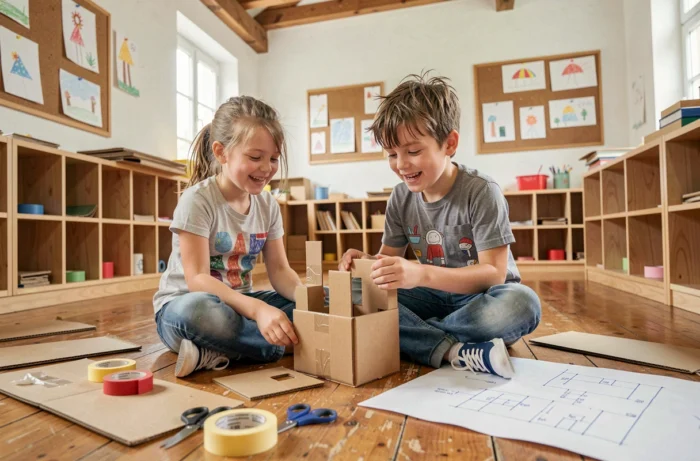
Space arrangement plays an underestimated technical role. We are not talking about “creating a creative corner” (a piece of advice found everywhere) but about specific parameters that modify the child’s creative behavior.
Structured disorder, first. A space that is too tidy, where every object has its designated place, inhibits unexpected associations. A bin containing heterogeneous materials (caps, string, cardboard, pebbles) invites unexpected combinations. The mixing of materials not intended for the same use provokes divergent thinking.
Autonomous access, next. If the child has to ask for permission to take scissors, glue, or paper, creative spontaneity extinguishes before it even starts. Adapting storage to their size and risk management capacity removes the most common barrier.
Finally, moments of emptiness. Boredom remains the most powerful creative trigger and the hardest to preserve in a structured daily routine. A child whose every half-hour is planned does not have the mental space to invent. Allowing periods without activity or screens, even short ones, creates the conditions for boldness.
Creative Confidence and Managing Failure: A Technical Learning
Creative boldness is a skill that can be trained, not an innate character trait. The mechanism is identifiable: a child who associates their attempt with a negative judgment (mockery, immediate correction, comparison with a peer) develops an aversion to creative risk that can persist for years.
The technical response involves an explicit framework:
- Systematically naming mistakes as “attempts” in everyday family vocabulary, rather than sporadically.
- Exposing one’s own creative failures as a parent, without dramatization or moral lessons. Showing a failed drawing or a burnt dish and laughing about it normalizes imperfection.
- Avoiding models to reproduce (pre-drawn coloring pages, kits with expected results) in favor of open instructions (“build something that rolls” rather than “build this car”).
A child who knows that failure is part of the process dares more than a child protected from all disappointment. This distinction between protection and stifling boldness remains the blind spot of many well-intentioned educational approaches.
The development of creativity in everyday life relies less on the activities proposed than on the quality of the adult’s response to the child’s attempts. An environment where one produces, where one fails without consequence, and where new ideas receive curiosity rather than evaluation creates children who dare, in all areas.